Why Some People Feel Expensive (Even When They’re Not)

There’s a certain type of person you can’t quite explain.
They don’t have to be the best looking in the room.
They’re not always the loudest.
They’re not trying the hardest.
But somehow…
They feel expensive.
Not in a flashy way.
Not in a designer-label, look-at-me way.
In a way that makes people pause.
Adjust themselves.
Pay attention without being asked.
It’s Not About Money
You can’t buy this.
You’ve seen people wearing $2,000 outfits who feel cheap.
And you’ve seen someone in a plain black tee who feels like they own the room.
Because “expensive” isn’t about what you have —
it’s about how you carry what you have.
Expensive Is Controlled Energy
Most people leak energy.
They move too fast.
React too quickly.
Talk too much.
Fill every silence.
It creates a sense of urgency.
And urgency feels like pressure.
Pressure doesn’t feel expensive.
Control does.
The people who feel expensive:
don’t rush their movements
don’t react instantly
don’t chase attention
They decide when to move, when to speak, when to engage.
That control creates space.
And space creates presence.
They’re Not Trying to Be Liked
You can always feel when someone is trying to win you over.
It shows up in:
over-smiling
over-explaining
over-engaging
It’s subtle, but it shifts the dynamic.
Now they’re asking for approval.
Expensive people don’t do that.
They’re not cold.
They’re not rude.
They’re just… not performing.
They’re comfortable letting you come to them.
Their Timing Is Different
This is one of the biggest tells.
Most people operate on fast timing:
quick responses
quick reactions
quick movements
It feels jittery. Reactive.
Expensive presence moves on a different rhythm:
a slight pause before speaking
slower, deliberate movements
measured reactions
Not slow for the sake of it —but intentional.
That shift in timing does something psychologically:
It signals that they’re not rushed.
And people who aren’t rushed feel like they have options.
They Don’t Over-Explain Themselves
There’s a natural tendency to fill gaps.
If something feels unclear, most people rush to explain:
what they meant
why they did something
how they should be perceived
But over-explaining lowers your position.
It feels like justification.
People who feel expensive are comfortable being slightly misunderstood.
They trust that:
the right people will get it
and the wrong people don’t matter
That restraint creates weight.
Their Movement Matches Their Mind

You can’t fake this part.
Movement exposes everything.
If someone is internally anxious:
their movements are sharp
their pacing is off
their energy feels scattered
If someone is grounded:
their movements are smooth
their transitions are clean
their presence feels settled
That’s why movement matters so much.
It’s not about being flashy.
It’s about being in sync with yourself.
They’re Not Always Around

There’s another layer to this that people don’t talk about.
Availability.
Some people are everywhere.
Every weekend.
Every event.
Always present.
And over time… you stop noticing them.
Not because there’s anything wrong with them —
but because familiarity lowers impact.
Then there’s the opposite.
The one who isn’t always out.
The one you don’t see for weeks… sometimes months.
And then one night—
“Wait… she’s here?”
Everything shifts.
People take notice.
Conversations change.
Energy moves toward them without effort.
It’s not just how they look or move.
It’s the fact that their presence isn’t constant.
It’s rare.
Scarcity Creates Weight
When something is always available, it becomes background.
When it’s limited… it becomes valuable.
That applies to:
time
attention
presence
The people who feel expensive don’t overextend themselves.
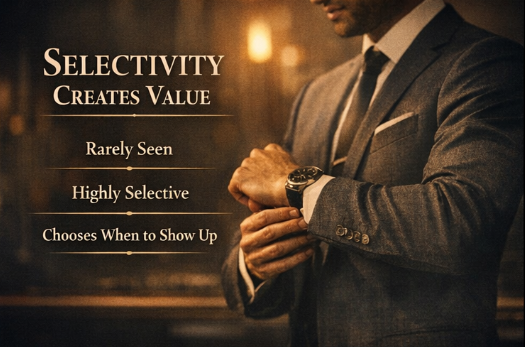
They’re selective about:
where they go
when they show up
how often they’re seen
Not as a strategy —
but as a reflection of how they live.
They have a life outside of being seen.
And because of that…
When they do show up, it matters.
It’s Not Disappearing — It’s Selectivity
This isn’t about playing games or being unavailable on purpose.
People can feel the difference.
Forced distance feels calculated.
Natural selectivity feels grounded.
The difference is simple:
One is trying to create value.
The other already has it.
They Use Less… and Get More
This is the part most people miss.
They think:
more talking = more influence
more movement = more attention
more effort = better results
But the opposite is often true.
The people who feel expensive:
say less, but it lands harder
move less, but it draws more attention
do less, but it feels more intentional
They don’t waste motion.
And because of that… every action carries weight.
You Feel It Before You Understand It
That’s the thing about presence.
You don’t analyze it in real time.
You just feel:
“there’s something about them”
“they carry themselves differently”
“I don’t know why, but I notice them”
And when you break it down…
It’s not magic.
It’s:
control
timing
restraint
comfort in their own body
and rarity
Built, Not Bought
Just like everything else in this space — this isn’t something you’re born with.
It’s built.
Through:
repetition
awareness
discipline
experience
You learn to:
slow down instead of speeding up
pause instead of reacting
choose instead of chasing
show up less, but with more intention
And over time…
Your presence changes.
Not because you’re trying to look expensive —
but because you’ve removed everything that feels cheap.


Comments